Many varieties of the lute family are available from 6crs to 13crs and a student theorboes and archlutes based on Sellas, as seen in the 'Instruments' section on the main website jminstruments.com or the lutes in stock page with the cheapest lute starting from £884 (without case, UK only of course). Instruments are based on originals in museums such as Hans Frei (KHM C34), Hans Burkholtzer (KHM NE48), and the Tieffenbrucker family (KHM C36, etc), with hand carved roses, not generically named models based on composers or periods in music and certainly not with soul-less laser-burnt out roses.
Many varieties of the lute family are available as student lutes or cheaper lutes and not just restricted to one or two models, if your new to the lute then Lynda Sayce, the Lute expert, explains its long and complicated history in the Lute Roadshow seen here on the Lute Roadshow The student range has allowed students and universities who can't afford to own a multiribbed or expensive decorative instrument to own a hand made lute for less, providing a suitable alternative to the mass produced generic instruments seen online. Some factory made lutes from Turkey tend to be constructed more like oud's, heavier with oud barring not like the lutes and a basic unauthentic plastic or flat machine cut rose. The student lute range allows you to have a luthier-made instrument at an affordable price, in some cases cheaper than the 'pro' lute range offered by one online retailer. Budding lute players may say they don't care if the body shape and barring is authentic but some have a higher string action which needs remedial work, as commonly remarked about on by lute teachers, makers and online lute shoppers. Conversions are then required costing more money to make a soundboard closer to the original barring as seen here , it needed converting as requested by the owner John Peck, lute teacher.
Interview with the maker shows the student lute after Tieffenbrucker C36 being played and explains the origins and philosophy behind the range. I originally learnt how to make one at school, with help from teachers and a professional lute maker, inspiring the need for affordable lutes which are enjoyable to play and new audiences to enjoy. If waiting for a lute takes too long then stock is made as seen here a 5 crs Medieval Lute. The student range has been proved popular over the last decade, the range is increased each year such as creation of the student lute-guitar based on Maler listen to it here. It's light-weight, authentic construction, is based on Maler (MI 54), unlike the many heavy instruments commonly found online. It has a 65cm string length, tuned in e' with lute intervals but can be tuned as a guitar too, no string changes just tuning up a semitone to play modern guitar music/ transcriptions,baroque guitar and mandora/gallichon music. You can still play almost all renaissance lute tablature, duets with lute or voice, or tenor in ensemble in lute tuning.
In 2015 the scaled down student Quito Vihuela was created for Richard MacKenzie listen to it here. The savings then can be spent on facsimiles of lute tablature, or lessons with a lute teacher, or a different student instrument. Below are examples of popular models, from top to bottom; Sellas student theorbo E.547 (an invisible folding mechanism option is available), an 11 crs Student lute is available and can be heard here playing a newly discovered manuscript in Ghent and on this Tombeaux CD- A Secular Requiem played by Richard Mackenzie on Spotify, based on Frei C34, the left handed version shown below it is a 13crs bass rider version, 7crs student lute in g' based on Frei C34, 7crs student lute in f' based on Tieffenbrucker C36 (as seen in the Interview with the maker news article), 14crs student chitarrone based on Tieffenbrucker (RCM26):


The Paduan Theorbo version of the Sellas E547 has been re-created from music scholar and composer Praetorius' Syntagnum Musicum II de Organographia woodcuts as seen above, this has been a valuable catalogue of instruments in scale drawings.The instrument is almost the same size or just short of the folding theorbo when folded so the case is cheaper too and no extra cost for a folding mechanism needed. The original size of the Paduan theorbo is projected as 96cm with 128cm basses, the Sellas has a string length of 85.7cm so therefore has basses of 114cm in loaded Nylgut, since loaded strings were available for 7crs lutes already (iconographical evidence according to Aquilla) then the Paduan Theorbo is likely to have had them as basses rather than plain gut, allowing for a shorter neck but the same volume as the long plain gut basses. Of course if you are not too worried about authentic stringing then louder D type wound basses can be used.


Made with heartwood yew ribs, bog oak fingerboard and ebonised neck and peg box with ebony sound board edging, can be heared here. It can be played as a double strung 10crs in g (a=392Hz) or a single strung 11crs in f (a=415Hz), two instruments for one!


A popular model based on Hans Frei C34, tuned in g' (a=440Hz) 61cm string length, CD basses with NNG trebles. This is an upgraded version with points on the fingerboard, ebony egding and black rib spacers, ribs in figured ash, pegs in natural pear wood and a bridge in ebonised pear wood, neck and peg box in ebonised maple with a black bog oak peg box bottom and fingerboard. Frets in Aquilla's LS nylgut for long lasting frets up to the 8th fret to allow for tuning in 1/6th temperament alternative positions


The above Liuto Attiorbato is based on the Sellas E1028 tuned in g' at a=415Hz in NNG and CD basses string length is 59cm with 84cm basses as per the original, the 1st crs is currently double as per the original but can be made single if desired of course by removing one string. The last two basses are D type as Aquilla don't do thick enough CD strings for the tension needed for the lowest courses, some may say D type basses are anachronistic as these strings were invented after the Liuto Attiorbato was however it can be strung single through out too with larger holes for thicker/higher tension 'D' type strings for all basses. The D type bases are a bit louder than double stringing and some may prefer single stringing as some customers I know do and seen being played by pro lute players such as Luca Pianca. Ribs are Yew heart and sapwood ribs some occasional knots as seen and black poplar spacers between the ribs, figured maple neck and extended neck, 7000yr old Bog oak fingerboard (and upper nut) which is an eco alternative to using ebony, Alpine spruce soundboard with original simple sellas rose which helps reduce the total price. Ebonised pear wood bridge and pear wood pegs with black stained collars. The lower nut has wider /more comfortable spacing than the original which is quite close.

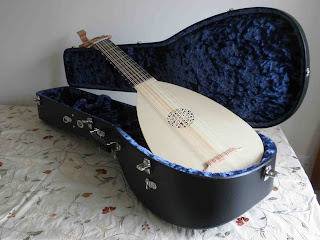
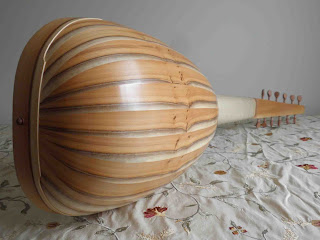


In 2015 the scaled down student Quito Vihuela was created for Richard MacKenzie listen to it here. The savings then can be spent on facsimiles of lute tablature, or lessons with a lute teacher, or a different student instrument. Below are examples of popular models, from top to bottom; Sellas student theorbo E.547 (an invisible folding mechanism option is available), an 11 crs Student lute is available and can be heard here playing a newly discovered manuscript in Ghent and on this Tombeaux CD- A Secular Requiem played by Richard Mackenzie on Spotify, based on Frei C34, the left handed version shown below it is a 13crs bass rider version, 7crs student lute in g' based on Frei C34, 7crs student lute in f' based on Tieffenbrucker C36 (as seen in the Interview with the maker news article), 14crs student chitarrone based on Tieffenbrucker (RCM26):

Hear the Canarios by Kapsberger being played on this theorbo below:
A Smaller version (79.2cm) of the Sellas theorbo with hardwood English yew ribs can be heard below, apologies for my playing it's not as good as Richard's of course:
For sale 2026: Theorbo based on Sellas (E.547)/ Paduan Theorbo version


The original Paduan Theorbo is 16crs but there's not much music for 16crs so the standard 14crs tuning in 440Hz is used. The ribs, neck and pegs are in slightly figured, varied toned natural pear wood, ebonised maple extended neck and ebonised pear wood bridge with black bog oak fingerboard. The larger rose is the same as the Sellas E547 as is the smaller bass rose. This arrangement has not survived well overtime on museum instruments, and the few Paduan theorboes that were made haven't either making some doubt if they existed but I don't think Praetorius would have included a fictitious instrument in an accurate survey of instruments at the time (1614/15), some may have been converted to longer necked theorboes out of popularity but some theorboes with two sound holes do exist as do a few paintings as seen below being held by Lady Mary Wroth.

The original idea of a bass rose may have been invented by composer for archlute and chitarrone Alessandro Picinini in 1594 as an unusual ('experimental') instrument with a longer body than it's neck exists in the museum in Vienna as seen below:

This was made by a well known luthier, in Padua too! a forerunner of the Chitarrone, but it's easier for the luthier to extend the neck than the body, and easier to play too! The paduan theorbo can be heard via You Tube played by Tomas Korula (heard here) originally an inspiration to make this instrument available in the first place. Below is a recording of this instrument:
£2849 (+case £783)
Also owned by Richard is the student 11crs Baroque lute after hans Frei seen below:

A left handed 13crs version is seen below:

Below a lovely performance on a gut strung version of the student lute, the gut strings will be an extra few hundred pounds on top but at least the instrument is affordable to make a luxury possible for a student:
A 10/11crs Laux Maler student lute as seen below
Hans Frei C34 in 7crs is a popular model, seen in figured Ash below:

Attentively in English Heartwood Yew (the clasp has some sapwood/creamy white wood)

For sale 2026: 8crs Student lute based on Hans Frei
A popular model based on Hans Frei C34, tuned in g' (a=440Hz) 61cm string length, CD basses with NNG trebles. This is an upgraded version with points on the fingerboard, ebony egding and black rib spacers, ribs in figured ash, pegs in natural pear wood and a bridge in ebonised pear wood, neck and peg box in ebonised maple with a black bog oak peg box bottom and fingerboard. Frets in Aquilla's LS nylgut for long lasting frets up to the 8th fret to allow for tuning in 1/6th temperament alternative positions
£1385 (case to be ordered if needed £308 shuster case or fitted case from Kingham)
The 7crs Tieffenbrucker C36 student lute (below) is a bit more volumous in body and longer in string length so more suitable for the taller amongst us...

For sale 2026: 7 crs Renaissance lute
based on Wolfgang Wolf (Stadtmuseum Fussen Nr4669)


This interesting instrument by Wolfgang Wolf survives as a rare 12crs lute so didn't get converted to a later baroque lute as many did so has some interesting marks on the soundboard hinting at it's earlier life, I decided to make as it may have been originally made by Wolfgang Wolf in Fussen as a 6 or even a 7crs. The 7crs was chosen as it allows for more repertoire to be played, tuned in g' 61.5cm string length. Ribs are a mix of various shades of heartwood and sapwood Yew, slightly figured maple neck and peg box with pear wood pegs and bridge, black bog oak fingerboard (an eco-alternative to using ebony). The body is smaller in width than the popular Frei lute but noticeably deeper in depth as seen above (15cm). The instrument can be bought with a custom made Kingham case or the cheaper 'shuster' hard plastic case at £311, however the case is a pre made so not made to measure, so extra padding around the body sides inside is required.
£1771+ case £311
Below is a Liuto Attiorbato, the latest addition to the student range which is in essence a 7crs lute with extra basses, allowing you to play renaissance lute music, since the tuning is the same, but also Italian baroque lute music since the same tuning was used so two instruments in one!
For sale 2026: 14crs Liuto Attiorbato for sale based on Sellas (Paris E1028)
The above Liuto Attiorbato is based on the Sellas E1028 tuned in g' at a=415Hz in NNG and CD basses string length is 59cm with 84cm basses as per the original, the 1st crs is currently double as per the original but can be made single if desired of course by removing one string. The last two basses are D type as Aquilla don't do thick enough CD strings for the tension needed for the lowest courses, some may say D type basses are anachronistic as these strings were invented after the Liuto Attiorbato was however it can be strung single through out too with larger holes for thicker/higher tension 'D' type strings for all basses. The D type bases are a bit louder than double stringing and some may prefer single stringing as some customers I know do and seen being played by pro lute players such as Luca Pianca. Ribs are Yew heart and sapwood ribs some occasional knots as seen and black poplar spacers between the ribs, figured maple neck and extended neck, 7000yr old Bog oak fingerboard (and upper nut) which is an eco alternative to using ebony, Alpine spruce soundboard with original simple sellas rose which helps reduce the total price. Ebonised pear wood bridge and pear wood pegs with black stained collars. The lower nut has wider /more comfortable spacing than the original which is quite close.
£2367 not including a case (Kingham case up to £864)
Student Magno Tieffenbrucker Chitarrone

Heard here
The student Mandora for those interested in the very late period of the lutes evolution
Back is made of heart and sapwood English Yew/ with some unavoidable knots thus cost less and used for student lutes, but some like that look, hear it being played below by Richard Mackenzie:
An Electric Mandora, commissioned by Chris Hirst, takes the lute to another new level playing Yesterday by the Beatles below:
A contemporary of the Mandora was the 6 course guitar or 'Mozart 'guitar as Richard calls it and here he is playing Brescianello below:
Also playing an ancestor of the classical guitar is the Student (Quito) Vihuela
For sale 2026: Vihuela de Mano/ Quito Vihuela


A new version of the student scaled down 'Marianita' vihuela or Quito Vihuela at 61.5cm tuned in g' (a=440Hz) same as the lute but guitar shaped, a type of 'lute-guitar' but better sounding than the heavier built cheaper alternatives. The body is made in English yew with some characteristic small knots and sapwood which seems popular for its 'woody' look. Neck and peg box in ebonised maple with natural pear wood pegs, black bog oak fingerboard and a headstock veneer, ebonised pear wood bridge and end pin, alpine spruce top with golden rose so could pass as a small baroque guitar if restrung, movable frets in LS nylgut by Aquila. Case can be bought separately would fit a standard 3/4 size standard guitar case.
£898 (case can be bought separately usually, soft £15- hard circa £90)
A Hire lute is available for beginners via the Lute Society Uk (No 48 Hans Frei C34) or musicians/composers to try out new instruments for as long as required, and explore the vast printed resources of tablature for many different types of lutes from renaissance to late baroque. The student lutes are made with less ribs and materials that are slightly less expensive but this has minimal effect on reducing the overall cost, but the real cost reduction is made by working for less so you can have more and get you on the lute-ladder. Usually such customers have returned to order more instruments. Construction time isn't reduced too much, only by less ribs, simpler rose design but not flat and machine cute, still nice looking like the Hans Frei C34 original rose.It's important your first instrument does not put you off playing altogether string spacings are comfortable, and different sizes of student lutes are available, such as the Frei C34 and the Tieffenbrucker C36, as one size doesn't always fit all. All wood is sourced from specialist suppliers of quality soundboards and quarter-sawn kiln dried woods and eco-friendly bog Oak is encouraged as a suitable black wood replacement for ebony.
The most popular student lute is the 7crs Hans Frei C34 student lute in g' at 61 cm, a comfortable body depth and shape as most have said and 7crs covers most of the Renaissance lute repertoire. There are some 'student lutes' made by oud makers and or very cheap lutes online claiming to be after Hans Frei but these are not the same shape/design as the original instrument in the museum, thus likely not to be authentic barring inside too.
The Student Chitarrone was created to make the Chitarrone/Theorbo more accessable to existing players who desire to play continuo and solo without spending a small fortune. The cost has been reduced considerably by making the back out of 17 ribs rather than 51! Lutenists such as Alex McCartney have ordered a student Chitarrone and a 10/11crs Frei after, here them at Veterum Musica. The rose is the same as the original, a simpler one can be ordered, and the soundboard has a protective ebony edging as does the extended neck. The fingerboard has the usual student simple join without points. This instrument can be made as a folding theorbo as was the Sellas E547 Student theorbo in 2013, hear here! for Oxford Graduate Lutenist/Scholar Richard MacKenzie He was the first to order the folding theorbo as well as many of these student lutes, his first was made in 2004, and heard here in the ensemble Mascherata, and often on Renaissance Fm click!
Other instruments have included a student Mandolino now owned by Lynda Sayce, and a Romantic Terz guitar for Jamie Akers, if you are interested in ordering one of these but is not currently in stock please contact info@jminstruments
The intention is to get more people playing by offering a wide variety of affordable instruments of different periods and theres plenty of online tablature and digitised manuscripts even for the specialised instruments like the mandora/gallichon via here Explore, enjoy and get playing this lovely music!


No comments:
Post a Comment